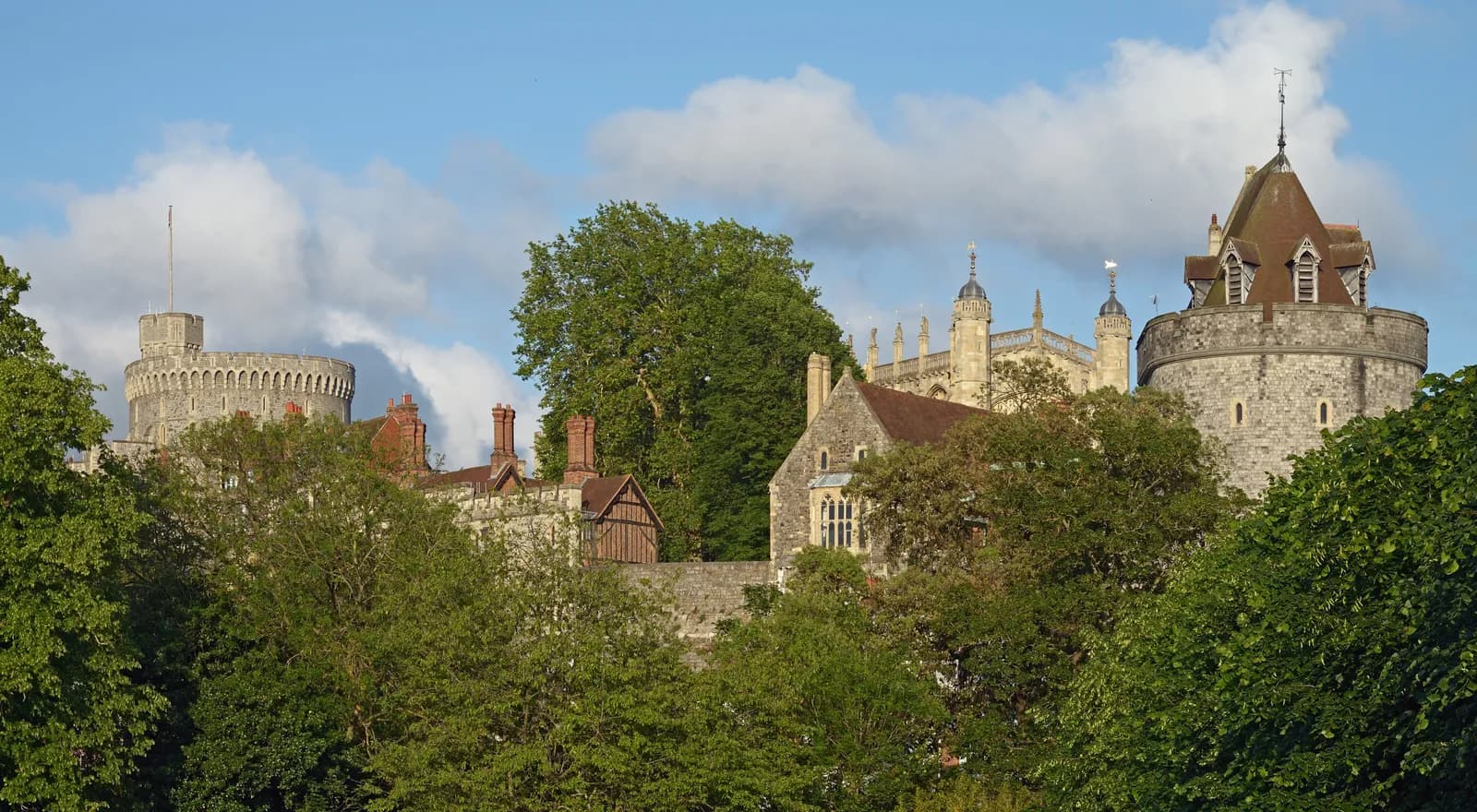
Windsor Castle stands upon a chalk ridge above the River Thames, its silhouette visible for miles across the Berkshire countryside. As the longest-occupied palace in Europe, it has served as a royal residence for more than nine centuries, intertwining the history of the monarchy with that of its host county.
From Norman Fortress to Royal Seat
William the Conqueror chose the site in the 11th century, constructing a motte-and-bailey fortification to guard the western approaches to London. The original timber keep was replaced with stone by Henry II between 1165 and 1179, establishing the foundations of what would become England's largest castle. The Round Tower, which dominates the structure today, retains its 12th-century base though it was raised by 30 feet in the early 19th century under the direction of architect Jeffry Wyatville.
The castle occupies 13 acres within the Royal Borough of Windsor and Maidenhead, making it a landmark of both national significance and immediate local presence. Its Grade I listed status and scheduled monument designation recognise the site's exceptional architectural and historical importance.
Medieval Magnificence and the Garter
Henry III commissioned a luxurious royal palace within the castle walls during the mid-13th century, transforming the military fortress into a comfortable residence. His successor Edward III undertook what historians describe as the most expensive secular building project of the Middle Ages in England, reconstructing the palace on a grander scale between 1357 and 1363.
Edward III also founded the Order of the Garter at Windsor in 1348, creating a chivalric institution that remains active today. The order's motto, "Honi soit qui mal y pense" ("Shame on him who thinks evil of it"), reflects its noble origins. Membership is limited to the Sovereign, the Prince of Wales, and no more than 24 companions. St George's Chapel, built between 1475 and 1511 in the Perpendicular Gothic style, serves as the order's spiritual home and houses the tombs of ten monarchs including Henry VIII, Charles I, and Queen Elizabeth II.
The Castle and the Town of Windsor
The prosperity of Windsor has been inseparable from that of the castle since the medieval period. By 1332, New Windsor ranked among the fifty wealthiest towns in England, its economy sustained by the royal court and the pilgrims who visited St George's Chapel. The earliest bridge across the Thames between Staines and Reading, first documented in 1191, underpinned this commercial success by facilitating trade and travel.
Queen Victoria made Windsor Castle a centre for royal entertainment after taking up residence in 1840. The arrival of two railway lines in 1849 transformed the town into a destination for day-trippers from London, a role it maintains today. Modern Windsor, with a population of 31,560, continues to rely upon the castle as the anchor of its tourist economy.
Restoration After the 1992 Fire
On 20 November 1992, a fire began in the Queen's Private Chapel when a spotlight ignited a curtain. The blaze burned for 15 hours, damaging over 100 rooms including St George's Hall and the Crimson Drawing Room. More than 200 firefighters brought the fire under control, using over 1.5 million gallons of water.
The subsequent restoration cost £36.5 million and took five years to complete. The project was funded through public admission charges, the opening of Buckingham Palace to visitors, and a £2 million personal contribution from the Queen. The new hammer-beam roof of St George's Hall, designed by Giles Downes, is the largest green-oak structure built since the Middle Ages.
The House of Windsor and Modern Berkshire
King George V changed the royal house name from Saxe-Coburg and Gotha to Windsor on 17 July 1917, selecting the castle as the source of the new designation due to anti-German sentiment during the First World War. This decision bound the monarchy permanently to the Berkshire landmark.
During the Second World War, George VI used the castle as a refuge for the royal family during the Luftwaffe bombing campaigns. Queen Elizabeth II made it her main residence from 2011 until her death in 2022. The castle remains a working royal palace, hosting state visits, Garter ceremonies each June, and royal weddings including those of Prince Harry and Meghan Markle in 2018 and Princess Eugenie and Jack Brooksbank the same year.
A Living Monument
The castle's architecture represents a palimpsest of British history, layering Norman stone foundations, 14th-century Gothic elements, Baroque interiors from Charles II's restoration, and 19th-century Romantic modifications. The State Apartments, including the Grand Reception Room at 100 feet long and 40 feet tall, demonstrate the building's continued evolution.
Today the castle draws hundreds of thousands of visitors annually, supporting the local economy through tourism, hospitality, and retail. The Windsor Royal Station shopping precinct and the town's numerous restaurants and hotels depend upon this steady stream of guests. For Berkshire residents, the castle remains both a familiar landmark and a reminder of the county's enduring place in the nation's history.