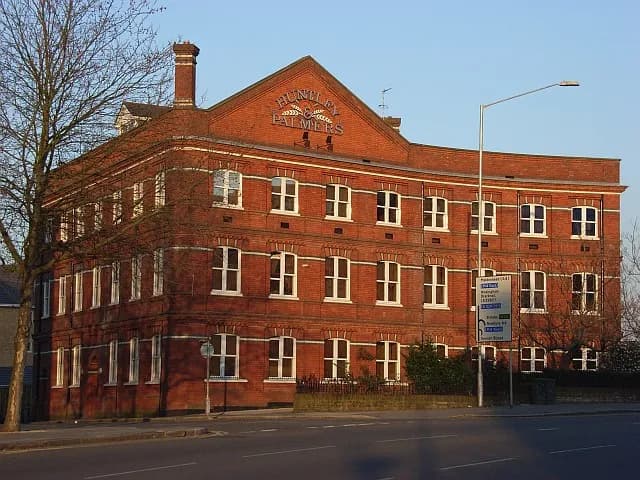
For more than 150 years, a modest shop on London Street transformed Reading into "biscuit town" and built the world's largest biscuit empire. The story of Huntley & Palmers is inseparable from the town itself; a tale of Quaker ingenuity, industrial innovation, and global ambition that started with a simple tin.
From Coach House to Factory Floor
Joseph Huntley founded the business in 1822 at number 119 London Street, then a small biscuit baker and confectionery shop serving stagecoach passengers travelling between London and the West Country. A Quaker schoolmaster from Oxfordshire, Huntley spotted an opportunity: coaches rattled over cobbled streets, breaking fragile biscuits. His solution was elegantly simple; he began packing biscuits in metal tins to prevent damage. This single innovation created two businesses: the biscuit company and Huntley, Boorne & Stevens, which became one of Britain's leading tin manufacturers.
By 1838, ill health forced Joseph Huntley to retire. His son Thomas took the reins, but the true transformation came in 1841 when George Palmer, another Quaker from nearby Buckinghamshire, joined as a partner. Palmer brought industrial manufacturing techniques and a vision of scale that would redefine the business.
The King's Road Revolution
In 1846, Huntley & Palmers opened a substantial factory on King's Road, strategically positioned beside the Great Western Railway. Palmer recognised that rail transport could distribute biscuits nationwide and eventually worldwide. The factory grew rapidly; it featured an internal railway system with its own steam locomotives to move goods efficiently around the sprawling site.
The numbers tell the story of extraordinary growth. Annual turnover rose from £2,700 in 1841 to £125,000 by 1857, the year Thomas Huntley died. George Palmer was joined by his brothers William Isaac and Samuel, and under their leadership the company continued to expand. By 1897, the year of George Palmer's death, annual turnover exceeded £1.25 million, with around 23,000 tons of biscuits produced each year.
Global Reach from Berkshire
By 1900, Huntley & Palmers had become the world's largest biscuit manufacturer, employing more than 5,000 people in Reading alone. The company produced over 400 different biscuit varieties, including the Nice biscuit which remains a British staple today. Its reach extended to 172 countries; biscuit tins bearing the Huntley & Palmers name reached Tibet, crossed Africa, and accompanied Captain Scott on his 1910 South Pole expedition.
Royal warrants from Napoleon III and Leopold II of Belgium confirmed the company's continental prestige. The distinctive decorative tins became marketing masterpieces in their own right, eagerly collected and treasured long after the biscuits were eaten.
The Three Bs and the Town's Identity
Huntley & Palmers formed one of Reading's famous "Three Bs" of industry, alongside Beer (Simonds Brewery) and Bulbs (Suttons Seeds). The company shaped local identity in lasting ways. Reading Football Club earned the nickname "the Biscuitmen" or "Biscuitboys", a moniker that survives today in fan culture if not official use.
The Palmer family left a more tangible legacy in Palmer Park, the 49-acre green space donated by the company's proprietors and opened on 4 November 1891. A statue of George Palmer, unveiled the same year in Broad Street and later moved to the park, commemorates a man who served as Mayor of Reading from 1857 to 1858 and as MP for Reading from 1878 to 1885.
Decline and Closure
The twentieth century brought challenges. Labour shortages during both world wars, changing consumer tastes, and competition from larger rivals all took their toll. In 1921, Huntley & Palmers merged with Peek Frean to form Associated Biscuit Manufacturers Ltd, later reorganised as Associated Biscuits Ltd in 1969.
The Reading factory, deemed too cramped for modernisation, closed in 1972; manufacturing ceased in 1976. Nabisco acquired Associated Biscuits in 1982, and while the Huntley & Palmers brand was briefly revived in 2006, production moved away from Berkshire.
Lasting Heritage
Today, Reading remembers its biscuit heritage through substantial archival collections. Reading Museum's Huntley & Palmers Gallery holds more than 7,000 items, including biscuit tins, photographs, oral histories, and advertising ephemera. The University of Reading Special Collections preserves business records spanning 1837 to 1995, comprising over 4,000 items.
The factory's former office block on King's Road survives as converted flats, and the "Biscuit Tunnel" beneath the railway lines, once used to transport goods to the factory, reopened in 2015 as a pedestrian and cycle path. A blue plaque at 119 London Street marks where it all began; where a Quaker schoolmaster's simple solution to a practical problem started a journey that put Reading on the world map.